
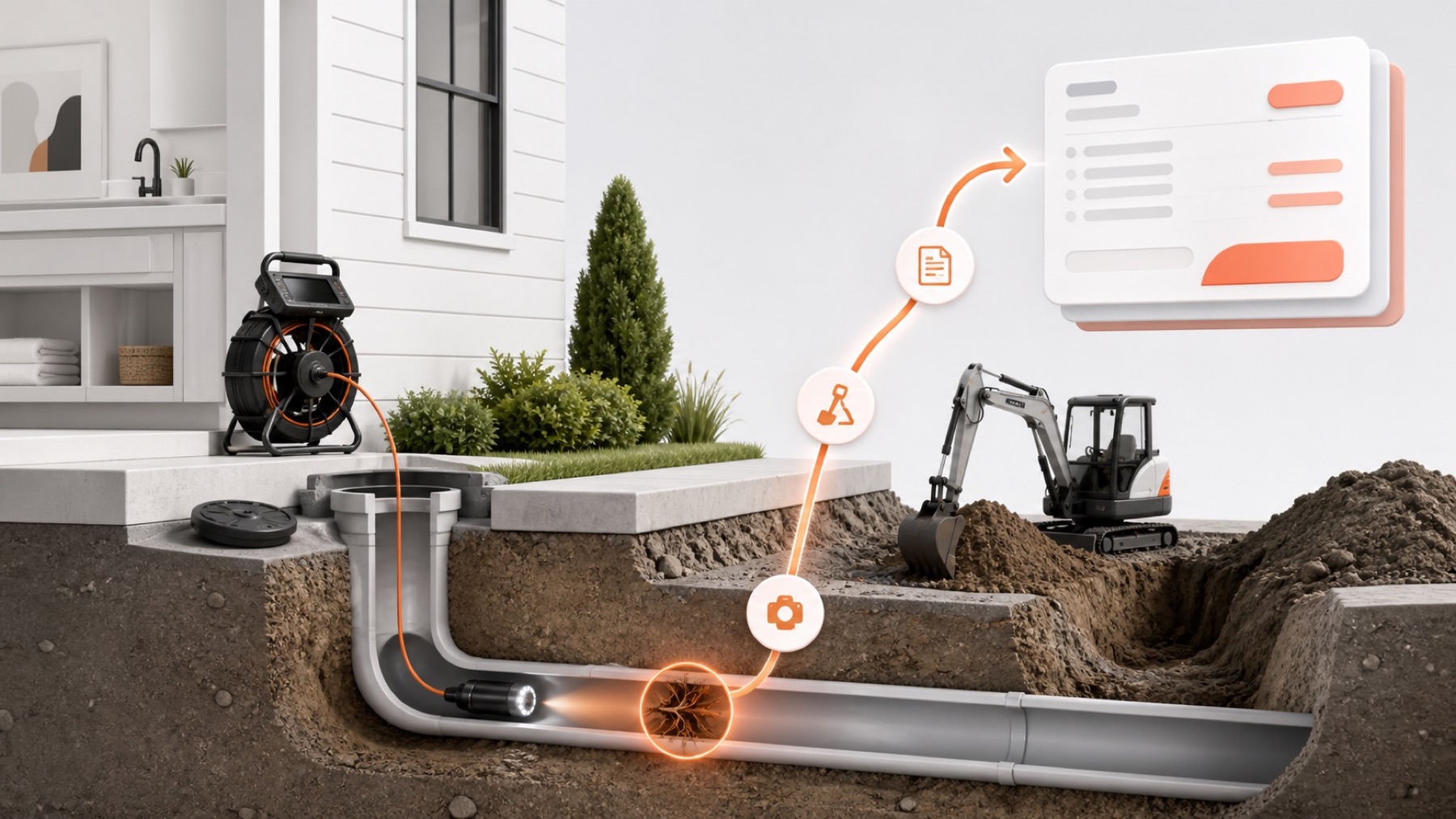
Sewer Camera Inspection to Excavation Estimate: A Plumbing Handoff Workflow
Build This In Joby
A sewer camera inspection can identify a serious problem without producing an estimate the customer can confidently approve. The technician sees roots, a break, a belly, or a questionable section, but the office receives a vague note and a long video. Days later, an estimator tries to reconstruct location, access, restoration, permits, and what the customer was told.
A dependable plumbing handoff converts field evidence into a scoped sales and production record. It preserves what is known, labels what still requires verification, and prevents an inspection finding from becoming an unsupported excavation promise.
Standardize the inspection record. Capture the service address, access point, direction of travel, approximate distance, observed condition, camera limitations, and whether locating equipment was used. Save useful stills or short clips with neutral notes. Do not treat a single blurry frame as a complete diagnosis.
Separate observation from conclusion. Record what the camera shows, then state the recommended next step. Roots, standing water, offset joints, and restricted visibility can have multiple causes. If cleaning, locating, access excavation, or another inspection is needed before final scope, say so explicitly.
Mark the problem area consistently. Use measurements, property landmarks, and a documented locating method where appropriate. Avoid promising an exact dig point based only on the camera counter. Surface conditions, bends, depth, and equipment accuracy can affect the final location.
Build a scope checklist before pricing. Confirm pipe material and diameter where known, estimated depth, access for equipment, utility-locate requirements, permit or inspection needs, spoil removal, bedding, backfill, pavement or landscaping restoration, and responsibility for interior protection. Unknowns should become allowances, exclusions, or required verification—not invisible assumptions.
Assign the estimate owner and deadline. Decide whether the inspecting technician, service manager, or excavation specialist prepares the proposal. Set a due time based on urgency and tell the customer when to expect the next contact. A technically strong inspection still loses trust when follow-up disappears.
Preserve options where practical. Depending on the verified condition, present repair alternatives with clear boundaries rather than forcing every customer into one unexplained scope. Each option should state what is included, what evidence supports it, and what conditions could require a change order.
Review the proposal before sending. Match the estimate to the inspection record, photos, location notes, customer priorities, and site constraints. Check quantities, restoration language, payment schedule, validity period, warranty terms, and exclusions. A second review is especially valuable on high-cost or permit-dependent work.
Handoff approved work to production. Carry forward the accepted scope, evidence, contacts, access notes, utility-locate status, permits, deposits, materials, subcontractors, and customer promises. Do not make the crew reopen the original inspection video to discover the job plan.
How Joby supports the workflow. Joby's customer and job records, documents, estimates, approvals, tasks, scheduling, and communication history help plumbing teams keep inspection evidence and next steps together. The contractor still determines diagnosis, code requirements, safe excavation practices, permit needs, and final scope.
The bottom line. The inspection is evidence; the estimate is a controlled decision. Standardize the field record, label unknowns, build scope from site conditions, and assign follow-up so a camera finding becomes work the customer and crew can understand.

'/%3e%3crect%20x='144'%20y='142'%20width='612'%20height='616'%20rx='34'%20fill='%23FFFDFB'/%3e%3crect%20x='808'%20y='142'%20width='648'%20height='616'%20rx='34'%20fill='%23262D36'/%3e%3crect%20x='198'%20y='198'%20width='198'%20height='26'%20rx='13'%20fill='%23FF845C'%20fill-opacity='0.18'/%3e%3crect%20x='198'%20y='244'%20width='320'%20height='22'%20rx='11'%20fill='%2324303A'/%3e%3crect%20x='198'%20y='286'%20width='244'%20height='16'%20rx='8'%20fill='%239BA4AD'/%3e%3crect%20x='198'%20y='344'%20width='504'%20height='272'%20rx='28'%20fill='%23FFFFFF'%20stroke='%23E9D7CC'%20stroke-width='4'/%3e%3crect%20x='238'%20y='388'%20width='186'%20height='18'%20rx='9'%20fill='%2324303A'/%3e%3crect%20x='238'%20y='426'%20width='424'%20height='14'%20rx='7'%20fill='%23C6CDD4'/%3e%3crect%20x='238'%20y='454'%20width='392'%20height='14'%20rx='7'%20fill='%23D8DDE2'/%3e%3crect%20x='238'%20y='510'%20width='190'%20height='42'%20rx='21'%20fill='%23FF845C'/%3e%3crect%20x='446'%20y='510'%20width='136'%20height='42'%20rx='21'%20fill='%23FFF3EC'%20stroke='%23FF845C'%20stroke-width='3'/%3e%3crect%20x='198'%20y='650'%20width='246'%20height='54'%20rx='20'%20fill='%2324303A'/%3e%3crect%20x='468'%20y='650'%20width='174'%20height='54'%20rx='20'%20fill='%23FF845C'/%3e%3crect%20x='874'%20y='212'%20width='188'%20height='22'%20rx='11'%20fill='%23FFFFFF'/%3e%3crect%20x='874'%20y='252'%20width='254'%20height='16'%20rx='8'%20fill='%2392A0AA'/%3e%3ccircle%20cx='1132'%20cy='434'%20r='136'%20fill='%23FFF5EF'/%3e%3cpath%20d='M1076%20435L1110%20469L1188%20391'%20stroke='%23FF845C'%20stroke-width='24'%20stroke-linecap='round'%20stroke-linejoin='round'/%3e%3ccircle%20cx='1132'%20cy='434'%20r='104'%20stroke='%2324303A'%20stroke-width='18'%20stroke-dasharray='18%2018'/%3e%3crect%20x='940'%20y='628'%20width='384'%20height='32'%20rx='16'%20fill='%23FFFFFF'%20fill-opacity='0.12'/%3e%3crect%20x='940'%20y='678'%20width='292'%20height='18'%20rx='9'%20fill='%23FFFFFF'/%3e%3crect%20x='1250'%20y='674'%20width='118'%20height='28'%20rx='14'%20fill='%23FF845C'/%3e%3cdefs%3e%3clinearGradient%20id='bg'%20x1='74'%20y1='74'%20x2='1526'%20y2='826'%20gradientUnits='userSpaceOnUse'%3e%3cstop%20stop-color='%23FFF4EE'/%3e%3cstop%20offset='1'%20stop-color='%23FFE5D7'/%3e%3c/linearGradient%3e%3c/defs%3e%3c/svg%3e)
